Showing posts with label Mission Moment. Show all posts

Tuesday, November 1, 2016

Mission Moment: November

Reminder: Mission Moments are the articles I write for my church newsletter back in the US; however, some content may vary slightly based on what I do or do not want publicly available on the internet and on being time-relevant as I write these articles about 2 weeks before they are published. October was a difficult month emotionally on both a personal and a professional level.  After six years in Guatemala, I attended my first funeral (the older brother of a student); two days later, I attended my second (a family member).  The second funeral caused me to delay my visits with interviewing new families by a day.

These visits were in a community where I had lived previously.  We conducted the visits over two days (and still have about three families to visit who had scheduling problems the days we were doing the visits), and the second day we got up into the part of town where I used to live; it was a little entertaining watching the shift go from “Hi, Zoila” (my community leader) to “Hi, Annalisa.”  That was probably one of the few “fun” spots in the two days.  While there’s something enjoyable and beautiful about meeting new families and hearing their stories (when they want to share), the stories are, for the most part, quite sad.

Zoila didn’t go easy on me either.  The first family we visited was probably the hardest one to hear.  It was a young woman who just wanted someone to love her for her, owes thousands of quetzales in debt she accrued getting medical services when her second child was born with a seizure problem (which he no longer has), and is now three months pregnant with her third child by a third man (who is out of the picture because her mother ran him off).  Her life has been threatened on multiple occasions as well as those of her children because she can't pay the debt.  Her house is just a few sheets of metal nailed to some wooden posts, and she hangs a sheet where a door should be; the rain comes in between her roof and wall in the rainy season.  (Fortunately for her, the rainy season decided to end a little early this year.)  She believes that her second child was born with the problems he had because she didn’t have proper care while pregnant with him.  When we passed through the next day, I brought her pre-natal vitamins and a vitamin-protein powder that is common here.

Many of the families I visited had children who had studied in the past and would like to go back to school but their family doesn’t have the money.  One which has me thinking a lot is a family where the woman’s husband left her to go to the United States.  He’s there now and no longer calls her or sends her money to help support their children (which, according to the Guatemalans, is the entire reason they go).  The woman’s brother has stepped up to take the financial responsibilities of father.  He quit his own educational goals to make sure she has everything.  However, without an education himself, he weaves to earn money.  While weaving can be quite lucrative, it’s very taxing on the body and is becoming less lucrative as machines try to imitate the weaving style of the artisans. I think I want to send him back to school as well.  I haven’t done something like that before with someone who is grown, but that doesn’t mean I can’t.

The school year is coming to a close here in Guatemala, and I’ll probably have gone out to Solola again before this article is published.  I’m excited to see how the school year went but a little nervous to find out which 6th graders will be pulled out of school because their parents are afraid to trust me and the project.  Manuel and I have talked about having a private meeting with all the students who are finishing 6th grade to see if we can keep them in school.  I don’t like going behind the parents’ backs, but Manuel is the one who suggested it, and since he knows his community, if he suggested it, I’ll be on board with it.

Wendy probably won’t be going back to school next year as her mother’s health continues to be poor.  Mercedes is now 18, and Manuel is going to see if she wants to go back to school as she no longer needs anyone’s permission to do so.

Everyone has a story.

Saturday, October 1, 2016

Mission Moment: October

I often get people who ask what I do here in Guatemala, and after explaining it to them, they often want to know if I can come to my project in their area.  So, a friend of mine who does fundraising for a lot of different projects sat down with me the other day and we crunched some numbers.  We learned that it currently only requires $250/month to add another location to the project; this amount may go up in the future if students start going to the university--but there are free universities in Guatemala if you’re good enough to get in--or saving their points to buy more expensive items as the point-money ratio is on a curve.
This provides school supplies to approximately 25 school children and food staples for 10-12 families, roughly 80 people.  Depending on the community leader and his or her level of initiative, this also provides secular and religious workshops for both parents and children.  For those of you who aren’t aware of how the program works, the students attend their normal community schools where they are given number grades starting in first grade.  Those number grades are then translated into program points which they can use much like money to purchase things from the program.  In Guatemala, a student needs to have an average of 60 in each class to pass the school year.  Because we know that accidents can happen, we push the kids to have a 70 in each class just in case that last marking period is a bad one.  (If they finish the school year with less than a 60 in 1-2 classes, they can take another test covering all of the material in that course from the whole school year.  If they have less than 60 in three or more classes, they have to repeat the school year.)  However, to earn a point, students have to get at least a 77-79 in a class; that lower range is a little flexible just because some kids just need to feel like they’ve accomplished something.  If they earn an 88, they receive 2 point in that class, and if they earn a 97, they get three points.  So, they’re actually earning the points which they use to buy the dry goods or shoes or school supplies or whatever else they choose to purchase through the program.

That being said, we’re hoping to add not one, but two, new communities next year.  Perhaps it’s a little optimistic, but as we’re not currently using all of our monthly funds, we do have some savings to hold us through until we get the ball rolling.  Even some Guatemalans have approached me asking how they can donate.  We’re planning on re-adding the other community I was working with in Solola the first year and perhaps adding a location in the town where I was living up until recently.  It’s all very exciting and I’m so glad that I can share this with you!

Monday, August 1, 2016

Mission Moment: August

Around December 2014, I went to visit the families in their homes.  This is something I do every November/December for families in the program.  I see their homes, their living conditions, weigh each child and get updated shoe and clothing sizes; I’ve also started taking height measurements.  I remember one visit fairly clearly.  It was the family of one of the widows in our program.  They knew we were coming, but when we got there, only the two school-aged children were there.  Manuel--my community contact and translator--and I chatted with them for a while.  When it was obvious their mother wasn’t going to show up, we gave them their Christmas gifts--cookies and a Bible--and prepared to leave.  For some reason we asked the boy if he could read, and he said no.  I double checked my records; the boy had just finished second grade and couldn’t read the words “Santa Biblia” (“Holy Bible”).  We thought it strange and mentally put some blame on the mother for not being involved in her children’s studies.  To be fair, the kids would skip out on their way to school and spend the day playing; so we felt blaming her was justified.

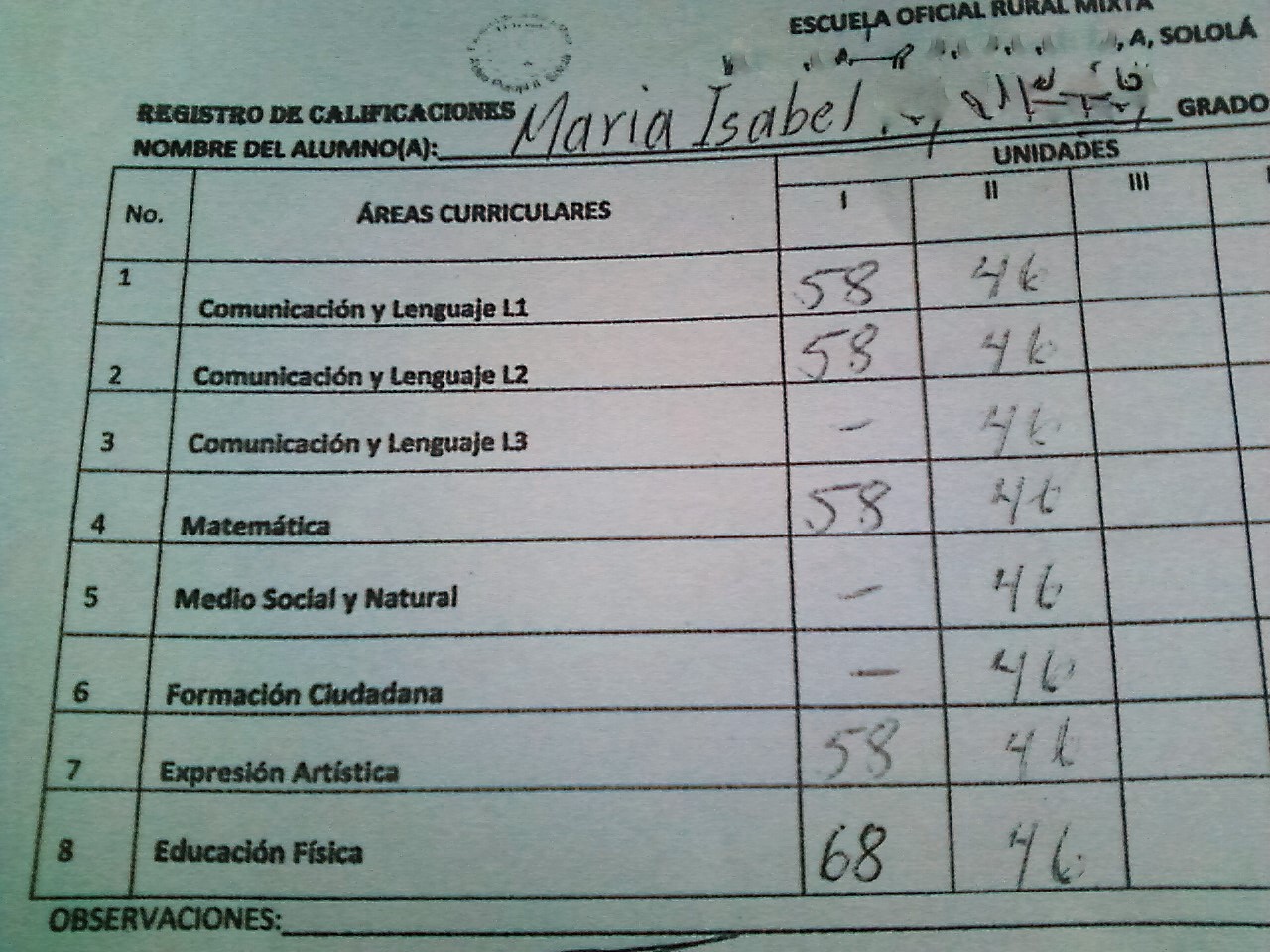
Fast-forward to June 2016, and we’re looking at the report card of a first-grader in that same village.
MITJ grades unit 2.jpg

During 4 marking periods, students have to have an average of 60 point in each of their classes.  (If they have below 60 in up to 2 classes, they can take a make-up exam covering material from the entire year; if they have less than 60 in three or more classes, they automatically fail the year.)  So, you can see from the picture why we were concerned about Maria Isabel’s grades.  We asked her mother why she got a 46 in every single class this marking period, and she said that she had asked about that.  We were instantly happy that this mother had at least been proactive about her daughter’s education.  She said that the teacher had “gifted” her daughter these grades because the teacher says that Maria Isabel cannot read or write.  First of all, did you all catch where I said this girl was in first grade?  Isn’t it part of the teacher’s job to teach these kids to read and write?  Maybe it’s slightly different in the US where there’s a higher level of literacy, but since most of the mothers and a few of the fathers in the program are illiterate--and they tend to be a good representation of their communities--it stands to reason that that responsibility would fall 100% on the shoulders of the teacher.  Second of all, did you see that last class?  It’s Physical Education.  Since when does reading and writing have anything to do with how well you can run around cones forward and backward?  How can we set these kids up for success when their own teachers aren’t doing their jobs?  How do I convince a sixth grader (and his or her parents) to continue studying when the educational system has completely failed them?

These are the questions I’m struggling with right now.  We told the mother to take the report card (or copy of it, rather) and talk to the principal, the advisory board, her community leaders, whoever would listen.  If they won’t listen to her (and her husband), then Manuel and I might take it up with the mayor.  We never inquired about these weird grades with Luis (the second-grader) because we assumed it was related to him not going to school half the time, but now I feel like we should have.

In other news, Manuel and I are looking into other possibilities for purchasing food supplies out in the Solola area. I’m also planning on spending about a week and a half with a family out in Solola to study Kaqchikel and coming home for four days and repeating that process until I learn the language.  It may deviate a little from that plan when it is put into implementation, but for now that’s what we’re planning.

Sunday, May 1, 2016

Mission Moment: May

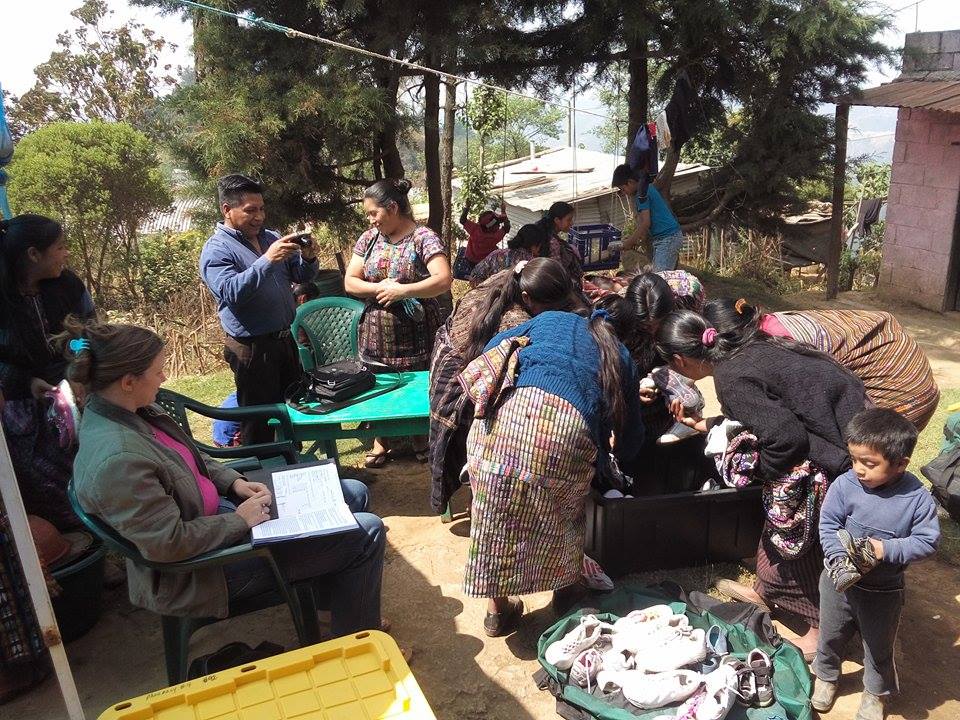
A couple weeks ago, Handsome had some time to accompany me to Solola.  I had been waiting for this because I wanted to take shoes out, and that’s a little difficult on the bus.  So, one morning we loaded two large, plastic totes full of shoes as well as three medium-sized duffel bags into his car and headed out.  I had planned this trip for February, but with our cat getting sick and eventually dying, we were busy with her.  With March ending, I really wanted to do what I said I would do back in February.

The families were happy to see us.  Most of the grades hadn’t come out yet; so many of them had fewer points to spend.  However, I know what the shoes mean to a lot of these kids; as one of the mothers told me the first year, “My son realized that he could earn things with good grades when I brought home the shoes.”  As a result, I allowed some of the families to go into “debt” with their points.  I’m hoping it turns out to be an investment that results in better grades.

In mid-April, I’m hosting a retreat in my house for missionary women who live in this area.  At time time that I’m writing this, it hasn’t happened yet; so I can’t tell you about how it went.  However, it’s put on by a website called Velvet Ashes, a site which ministers to women serving overseas.  This is the first time I’ve participated (and only the second time they’ve offered it online), but I decided to jump in with both feet and host a group.  I’m looking forward to getting to know some of the other missionary women in this area and learn about the work they’ve been called to do.

Language Learning

Your word in Kaqchikel for this month is “xajab” (sha-HAB).  (I don’t think I’ve given you that one before.)  It means “shoe” in English.  In Spanish, it’s “zapato.”  When I ask the kids (or their parents) what size shoe they wear, I say, “Ach kin numer xajab?” (Besides the last word, that’s all phonetically for those of you who are trying to learn Kaqchikel or for those of you who read the newsletter to someone else.)

I have one delightful woman in the program who only speaks to me in Kaqchikel.  Sure, she doesn’t know much Spanish, but she won’t even say “hello” (“hola”) or “goodbye” (“adios”) to me in Spanish.  I find it funny because this woman who has never even gone to school is utilizing one of the best ways to teach a language with me.  If all the rest of my parents would follow suit, I’d probably be fluent in Kaqchikel in no time.

12911007_1005410089541812_377346171_n.jpg
Some of the mothers looking for the perfect pair

Thursday, October 1, 2015

Mission Moment: September

These are the articles I write for my sending church's newsletter.  This one, in place of being titled "Mission Moment" was titled "Political Panorama."  Guatemala has been undergoing a lot of changes in the last few months which has caused a slow season for my project.


Frustrating.  That’s a word I don’t use a lot, but that’s the word I’m using to describe right now.  This article will have nothing to do with actual mission work and a lot to do with why things sometimes don’t work.
In February of this year, it was discovered that money was being stolen from the country of Guatemala via a customs scam.  When goods are imported to the country, the importer has to pay taxes.  The customs scam was allowing importers to pay much lower taxes for their goods with a nice “donation” to someone else.  In April, it was discovered that that “someone” was probably a couple high-ranking government officials, specifically the president and vice president of Guatemala.  And so began the protests.  Since April, people have been protesting at least once per week all over the country.  In May, the vice president resigned saying that she had nothing to hide and that by resigning she was allowing herself to be investigated.  The Guatemalan people called her bluff, and she went on the run.  The president said that despite the pressure of “a few” people, he had been charged with the post of president by the Guatemalan people and that he would not let them down by giving up.
Jump forward to August 21st.  Protests have become daily but remain peaceful simply blocking vehicle and pedestrian traffic.  In a moment of bad luck, the former vice president checks into a hospital, and she leaves in handcuffs.  Protests become constant with travel becoming essentially impossible.  The president sticks with his resolve that he has a job to do and will complete his promise to the Guatemalan people.  Then congress votes to remove the president’s political immunity meaning he can now be investigated as part of the custom’s scheme which has robbed the Guatemalan government of hundreds of thousands of dollars which affected the salaries and resources of hospitals, schools, and police among others.  The president resigns the next day, apologizing to the Guatemalan people, saying that he has some personal situations he needs to take care of.   The new vice president steps up to become president, and as he was one of the judges who overturned the ruling concerning General Rios Montt of the genocide cases during the Guatemalan civil war, no one is really sure if he’s just going to complete the last 4 months of the term he has been granted or if he’s just going to overthrow everything and turn the country back into a military dictatorship.  Indigenous people are not impressed.

One week later, normal elections are held to pick the new president of the country.  (Don’t be confused.  This has nothing to do with anyone resigning.  Just like the US, presidential elections take place every 4 years.)  A man who no one expected to win 4 months ago becomes the front-runner…probably solely because he’s not a politician and has no history of corruption anywhere in his family.  The fellow who everyone expected to win is in third place but demanding a recount of ballots.  If no candidate wins 50.1% of the votes, a run-off between the top two candidates follows in late October.  (Guatemala has somewhere around 18 political parties; not all of which necessarily had a presidential candidate running this year.)  But Mister Third Place was not the only one upset.  In many places, the vote was close, and in the weeks following, those who were not happy with the outcome had less-than-peaceful protests.  Ballot boxes were burned.  Police were shot.  And the mayor’s house in Solola might be torched for the third time in ten years and my community contact, Manuel, isn’t answering his phone…which is why I’m not traveling out to Solola to visit my families.  I don’t consider myself to be at any risk; however, the people in Solola are swift to carry out justice (i.e. lynching) against anyone they feel has wronged them…and Manuel is an advisor to the mayor.  So, until I can get a hold of him and until things have calmed down, I have no plans of going anywhere.

Please note: In most places, things are calm and orderly at this point.  Mister Third Place has dropped out.  However, many higher-ups are still being arrested as the story opens wider and wider.  Please be praying for Guatemala, but in no way, shape, or form should you think that I am in any danger.   

Thursday, January 1, 2015

Mission Moment: January

Mission Moment
I hope you all had a wonderful Christ-filled Christmas and a happy New Year. I will be spending Christmas with the future in-laws, joining in their holiday traditions and sharing with them some of my own.

As for “Educacion con Esperanza” (“Education with Hope,” it needed a name), I had some great end-of-year visits with the families. Manuel—the community contact with whom I work—drove me around to each of the houses. Each family received homemade Christmas cookies and a Bible for Christmas.

As with almost every visit, there were some highs and some lows. One girl did not pass her classes. She says that she likes school, but her parents say that she doesn't do her homework. Her brother dropped out this year because he felt stupid being a 15-year old in 4th grade. I hope that both of his younger sisters don't follow his example.
Ronaldo holding the Bible we distributed
to each family with his prosthetic hand.
(Yes, it's white.)

We visited another family who has two “special needs” children; one suffers from multiple seizures, and the other was born without his left hand. I found out that my suspicions concerning the educations of their sons was probably correct. The boy without a hand, Ronaldo, just finished 7th grade this year. His younger brother, Efraim, just finished 6th grade. While we were talking, their father stated that Efraim would not be returning to school in January. (Remember: The school year here is from January to October.) He would instead start working in the fields with their 3 oldest brothers because the family can't afford to keep sending him to school. Ronaldo would continue schooling because even with his prosthetic hand—which we obtained via another organization in March—he is not strong enough to do a lot of field work. So, we talked some more. Efraim has the best grades in the family. Via the program, he easily earns more points than are necessarily spent on him alone. In the end, dad decided to send both of the boys back to school in January.


One family prepared a special lunch for us. It was such a special lunch that they laid fresh pine needles on the floor. This is something reserved for only the most special of occasions—such as weddings—or the most special of guests. Our lunch was “caldo de gallina criollo” which roughly translates to “virgin hen broth.” It is completely delicious; it's actually my favorite dish that my future mother-in-law has prepared during my visits to their house. Basically, this family took one of their egg-laying hens which had not yet laid an egg and killed it and made soup with it. That hen was worth a lot of eggs still. So, when it came time to tell them—all of us sitting there in that beautifully pine-covered room—that they did not have enough points to buy school supplies for both of their daughters through the program—a fact I didn't know before eating lunch—I wanted to cry. In the end, I let them borrow points. It's not something I'd do for everyone, but as children who cannot go to school because of their age or physical/mental limitations receive 5 points every marking period, I knew, because of their youngest daughter who turned 3 this month, that they will soon “repay” the points. How did this happen? Well, the short version is that their family felt the need to buy more with the points than their daughters earned during the school year. This either means that the family's financial situation is really bad or that the girls simply aren't getting very good grades. Neither situation is ideal, but now that we've gotten through one year, we'll see how they improve.

We made one surprise visit during our trip. There was a family who had been selected to be in the program which had never come to a meeting. Supposedly, they had been informed of the meetings and simply not come. I know Guatemala, and I was a little skeptical that I was getting the whole truth. So, armed with just the family's name and a vague memory of where they live, Manuel and I set off to find them, and when we found them, I was glad we had gone to look for them. Due to a family emergency, they hadn't been able to attend the first meeting, and after that, they were never informed of any other meeting. It is interesting to me to compare our visit with them with those of the other families who have spent the last year getting to know and trust me. If I weren't used to it by now, it really would have been off-putting how closed they were to my presence.

Wendy, who I mentioned to you all in August 2013 when I first met them, and her family were excited to see me as always, and I was out of breath when I got to their rented house as always. Wendy will be starting 9th grade in January, and the question of what to do with her and Mercedes (who I'll talk about in a bit) is troubling. I won't say much more about them in this newsletter, but Wendy was very happy to receive the Bible. She said that she just started going to the youth group at church and that she felt it would be very useful to her.

Mercedes and her brother Luis are already signed up for school, something most families won't do until January. My fiance, during his visit at the end of September, had had a man-to-man talk with Luis about the importance of education and promised him a soccer ball if he would go back to school. It's not my style, but it was out before I could stop him. Luis agreed. (I just hope we don't have to buy soccer balls for all of the 7th graders.) I was a little chilly having left my coat in the truck; so they decided to give me a beautiful Christmas scarf that Mercedes had made. I was so cold that it didn't make much of a difference, but it is gorgeous all the same. I think in the future I'll use it with a coat.

So, this year Mercedes and Wendy will be the first two to graduate from 9th grade. Mercedes wants to go on to become a “secretaria bilingue” (a bilingual secretary, which is, by default, Spanish/English, not Kaqchikel), and Wendy wants to go on to become a “licensiada” (which is actually just a level of education that allows a person to be titled; I have yet to figure out in what subject she wants to have her “licensiatura,” but the most common is as a lawyer.) However, there are a couple of bumps in this path. First of all, there is no school in their immediate area which provides for schooling above 9th grade. They would have to pay around Q20 (round trip) and travel an hour (each way) to be able to attend high school. In one week, that would be Q100 for each of them. In a month, that would be Q400. In 9 months, that would be Q3,600 or $480 just in bus fare...just for one of them. Second of all, their education up to this point is probably a little lacking. One boy in the second grade told us that he hasn't yet learned how to read. Manuel says that's common which is why he actually moves his family into the city during the school year. However, these two girls have already accomplished more schooling than any of their parents and most of the village; so helping them catch up to where they should be to attend one of these school isn't something that anyone is very capable of.

All of that is why I'd like to bring them to live with me in 2016. And for 2016, that's fine if the families are interested. I have a spare room with a spare bed in my house. The girls could help me with my Kaqchikel, and I could help them with their English and any educational issues in general. However, at the end of 2016, Ronaldo will graduate from 9th grade. At the end of 2017, Efraim, Estuardo, and Luis will graduate. At the end of 2018, Marta Lidia and Olga Maria will graduate. So, if their families are willing (and I think they will be), in 4 years from now, I will have a household of at least 10, counting myself and my husband-to-be. There's a house here in town that would be perfect for housing us, but it's way out of our price range and your price range. However, this situation—specifically this house—is something I'd like to ask your prayers over in the coming year. In the past four years, I've found that if I am in a situation where I don't see the solution and suddenly all the pieces fall into place, that's typically the solution. I have at least two years before I would need something larger than the house I rent right now.

If you want to read more in-depth stories of my visits with the families, you can check out my blog: http://GringaOnTheGround.blogspot.com, if you have any questions, comments, life updates, or just want to get a hold of me, I can be reached at asimmer@gmail.com.

Language Learning
In November, we learned how to say “Good morning” in Kaqchikel. As most of my visits to families took place in the afternoon, I had to learn how to say “Good afternoon.” In Kaqchikel, this is spelled “Xqa q'ij.” The apostrophe in Kaqchikel is a glottal stop. I really wasn't sure what that was or how to do it until someone pointed out to me that Michiganders use it all the time in words such as “kitten” or “button;” it's that little stop that you do right about where that first t should be. If that doesn't do it for you, try “uh oh!” Try saying them out loud. Still not sure what I'm talking about? I'm betting you're probably not originally from Michigan or you've spent a considerable part of your life outside of Michigan. Anyway, back to Kaqchikel. My second struggle with this “word” was the space. It makes the glottal stop nearly impossible to hit; so forget the space is there. “Shcack-eeh” is about how it sounds, so incredibly different from the “buenas tardes” of Spanish or the “Good afternoon” of English.

Monday, December 1, 2014

Mission Moment: December

 I had a wonderful time seeing many of you when I worshiped with you on the 9th, and I had a really great group for the post-Bible Study meeting on the 11th. Thanks to all who came out! We had a great discussion, and we didn't have time to ask and answer all the questions that we wanted to ask and answer. So, we agreed that one of them I would answer here. It was asked "What are the three greatest needs in Guatemala?" This, to some extent, is a fairly easy question to answer, but how to fix them is a much more difficult question. (Prayer is a great start!)

First, although it is hard to quantify, I think that the faith life of these people is worth noting. Just as in the US, there are so many people who seem to be stagnant in their faith. They seem to do nothing most of the year, but then when the big holidays show up, they do them in grand style...sometimes so grand that they miss the entire point of the holiday. Additionally, many Catholics practice an odd form of Catholicism mixed with their traditional Mayan faith practices. Essentially, when the first missionaries (Jesuit priests, I believe, but don't quote me on that) came over, they found it easiest to tell the people that the practices that they were doing were actually commemorating Catholic saints and holidays and that they were simply doing them wrong...rather than risk telling the people that their gods were false and everything they knew about religion was false. It has created a fascinating but dangerous mix.

Second is a living wage. Minimum wage is about Q2,300 (roughly $300, but completely irrelevant as the economy is different too) per month, but most people don't earn that, especially the families I work with. All but one of the fathers is a day laborer; when there is work, a truck drives down the road picking up anyone who wants to work until the limit is reached. Anyone else goes without work for the day. If there is no work, everyone goes without work for the day. (The other father works in a barber shop where he pays most of what he earns to rent a clipper kit; that problem is already being worked on.) Just so you understand how quickly that Q2,300 for the month can disappear, let's assume that I get a minimum wage job in Antigua (pretty much the only place to get a minimum wage job around here) 6 days per week.
Public Transportation: Q4 (one way) x 2(ways) x 26 days = Q208
Lunch (chicken sandwich and tiny pop, the least expensive option): Q9 x 26 days = Q234
Other meals (beans and rice with tortillas, the least expensive option): About Q6 x (31 breakfasts + 31 dinners + 5 lunches) = Q402
Clean drinking water = Q9
House rent = Q600
Electric bill = Q30
Water bill = Q5
That's Q1,488 right there. And I am one person. Imagine supporting a family off of that. Two people (spouses, with only one working) would spend Q1,813 (doubling the water—both drinking and washing—bills and having the other person eat 93 meals of rice and beans during the month and adding in 4 weekly trips to Antigua for the second person to potentially buy vegetables and other necessary household supplies). And neither of those figures is including the soap to wash dishes and clothes nor toilet paper or any other household consumable. What about if they need to buy a uniform for their job or just need another piece of clothing in general? If their shoes wear out? If someone invites them to a birthday party (and have to buy a present)? There is only a Q500 barrier; there is no room to get sick or injured. Now consider the multitude of people who don't make minimum wage. There are no consistent government programs to help them. There are no food stamps. There is no Medicaid. There are no after-school programs. There are no free or reduced-price lunches. So, for people who don't earn minimum wage and for people with families, cuts have to be made somewhere. (For the record, my housing rent is extremely low; even if people owned their own land and house, they would probably be paying some reasonably similar amount on property taxes.) And if cuts aren't made, more people need to work to support the family. This second issue actually covers a great deal of issues, but let's press on.

I suppose the third issue would be the lack of education. Here I'm not just talking about going to school, although that is part of it. However, many professionals are lacking the knowledge and skills to be able to do their job properly. I have a very sadanecdotefrom a missionary in a nearby town. He works with special needs kids and even has a home for orphaned ones. A few months ago, one of his special needs girls went into respiratory distress. Two of his kids started driving the van for the hospital but called an ambulance on the way while he sat in the back with the girl monitoring her situation and eventually starting CPR when her heart started failing. They met up with the ambulance, made the transfer, and as her legal guardian, the missionary went with them in the back. It was soon quite clear that the paramedics had no clue what to do for the girl; so the man made them step aside and went back to caring for the girl. She arrived at the hospital dead. I'm not saying that she would have made it if they had known what to do, but I am saying that without the CPR there is nothing short of a miracle that would have gotten her there alive. The police and hospital staff face a similar problem; they are terribly under-equipped (sorry, that's a snuck-in, piggy-back #4). In the hospitals, it is sometimes the case of doctors taking the hospital goods for their own private practices, but—not to approve of their actions—the reality is that they probably couldn't get those supplies for their patients otherwise. However, I've also heard that some of the Guatemalan doctors have asked to work alongside the medical team that comes down every January in hopes of learning some of their techniques, and I know that US Border Patrol comes down to work with the Guatemalan police to make them better. Now, if only I could get past the fact that a university graduate didn't know that a raisin was actually a dehydrated grape...

The Care and Keeping of a Missionary
It really was quite a pleasure to be in fellowship with all of you in November. Thank you for that time. Thank you for your kind words. Thank you for your encouragement. I ask for your prayers for the 3.5 situations I've mentioned in this article; prayer changes things. Pray for those who are actively working to make a change and pray for the places where there is no one to help that change happen. Pray about being that change.
I look forward to hearing from any and all of you via e-mail: asimmer@gmail.com. Please feel free to send me questions about what I'm doing here, and I can try to answer those in future articles. And, although it hasn't been updated in a while, I also have been a bit better about making more regular updates on my blog which can be found at http://GringaOnTheGround.blogspot.com in case you don't want to wait for the next newsletter to come out!

Language Learning
If you remember, working with the families I work with, they don't always speak Spanish. And they CERTAINLY don't speak English. They speak Kaqchikel which is a Mayan language. Many people assume that it is a derivative of Spanish, but the Kaqchikel were living in Guatemala and communicating long before the Spaniards ever showed up. It was not a written language; so even today there is some disagreement about spelling, and there is some pronunciation variation between towns. Not that I've studied Korean, but Kaqchikel sounds like Korean to me.

This month's phrase is “Shoe-la.” (I have no clue how it is spelled, but that's how it is pronounced.) “Shoe-la” means “That's all” or “No more.” If you are eating at someone's house and they ask you if you want more food but you don't, you'd say “shoe-la.” If you are buying things at the market and you've checked off everything on your shopping list and the store attendant asks if there is anything else you want, you'd say “shoe-la.” I think the expression most similar in Guatemalan Spanish would be “Ya no,” but that's very Guatemalan and doesn't translate very well literally to English.

Saturday, November 1, 2014

Mission Moment: November

Again, this is the newsletter article for my sending church.  Due to the public-ness of this blog post, some information has been removed for privacy.

 So much has happened in the last month! At the very end of September, I had the opportunity to take my fiance out to Solola to meet the families I work with there. In addition to meeting them, he also had the opportunity to share his story with them. For many of the mothers in the program, they understand this struggle. Two of the ten women are widows. Among the other eight, at least one of them has an alcoholic husband who will drink any money he finds in the house. So, to meet a young man who comes from the same situation as their children are in and who is graduating from the university this year, it gives them hope.
At that meeting, we also checked the grades to see how the children are progressing. Most continue their slow progress upward. One boy's grades plummeted downward, and when I asked his father what was going on, he stated that his wife had lost a pregnancy (which is why she wasn't there), and that the boy was so worried about his mother that he refused to go to school. Sweet, but I really hope he brings his grades up in the last marking period; I don't want a lost pregnancy to be a lost year in school as well. I imagine that if I were in that financial situation, two stresses instead of one would not be preferred. On a happier note, one boy's grades skyrocketed! I asked his mother what happened. “It was the shoes,” she told me. The previous visit, I had brought shoes that they could buy for 2 points per pair. (With the rough calculation from dollars to “points,” it was about $1.) I had brought them for the people who had asked me to bring them, and then I had brought a few more to give some variety. After those who had asked for them had picked out their shoes, I allowed the other families to look through the remaining shoes. Anyway, this boy had received a new-to-him (secondhand) pair of school shoes, and, according to his mother, that got him excited about doing better in school and earning more points! Some of the girls are receiving low grades in gym class because they don't feel comfortable wearing gym shorts. We're looking at the possibility of sweat pants for next year as that is a uniform option that the school allows; however they do cost more than the shorts which is why lots of families don't get them.
We also had the chance to visit some new families which might be added to the program next year. At one house, a woman showed us what she does. Her eyes are no longer good enough to weave, but she does make baskets. It was a gorgeous basket with a lid, perhaps the size of a large saucepan. My fiance asked her how much she sells them for, and she said that she sells them for Q5 each once she has decorated them. (The one she showed us wasn't yet decorated.) Q5 is about 62 cents in US money. Needless to say, he bought it and paid her double (Q10), but we can't do that for everyone nor on a regular basis.
On October 1st, I had the opportunity to attend a seminar via the internet. (Bonus: it was free to online participants!) It was called “Helping Without Hurting,” and it's about the proper way to help people so that they don't become dependent on the help they are receiving. It gave me a lot of thoughts to take with me when I went to visit my families again.
So, two weeks later, I went to visit my families again. I had them sit in a circle with women from the different villages all separated so they could see the women they know best, and I asked them “What are you good at? What do you like doing?” I'm sitting there ready for someone to tell me that they love to write (even though all 10 of my mothers are illiterate), and for someone else to open up and say that she loves to paint (even though even the kids rarely have paint for school). And no one had an answer. The community leader said, “Well, they all weave. That's what they do.” Fine. “Well, what are they good at weaving? Do they have any particular shape they love to weave? Flowers? Birds?” Nothing. So excited about bringing this up, and nothing. So, I gave it one last shot. “What if there was one more hour in the day. No, I'm not God. I can't gift you another hour, but what if? The laundry is done. The dishes are done. The sweeping is done. The mending is done. There is nothing that needs to be done! What would you do?” Well, it got some of them laughing, but one woman said, “Well, I might like to learn how to use a sewing machine.” I asked her if she had ever used one before or if she would have to learn, and she said she would have to learn...but that it was something she'd like to do. And before long, I had about 7 women who were thinking that a sewing machine sounded like a great idea. And another woman said that her husband is a barber, but that he is paid little where he works because he has to pay to use the clippers of another guy. “He's a really great barber, but he needs his own clippers.” I asked them about their dreams for themselves, and most of them said that they would really love to have a real house; one man went so far as to remind me that his kitchen is just 4 poles with tarp wrapped around it. (Don't worry. I haven't forgotten.) One woman said she'd like to learn English to communicate with me better; I told her I'd trade her English classes for Kaqchikel classes for the same reason.
So, the community leader, in front of everyone, decided to ask me how possible these houses were. I said that I really don't have that kind of funding, but if we can work towards sewing machines as a group, the women themselves can work toward houses. The women weave, but they don't have anyone to sell the weavings to as all of the women do the same kind of work. So, people come along and they pay them $10 to weave these typical shawls. If the women can sew the two halves of the shawls together (with a sewing machine), they can earn $31 per shawl. Note: as a beginner, I have been working on something the size of one half of the shawl for about 5-ish months (off-and-on for a year and 2 months), and while I've seen my time go from 2 hours per row to 45 minutes per row, these women are at least twice as fast as I am and dedicate much more time to it per day. Still, assuming that they can do the entire shawl in 1 month, they are earning $10/month or roughly 33-cents per day. Once the harvest is over, that is the only income the family will have for a couple months.

The Care and Keeping of a Missionary
I am looking forward to seeing you all in November. I will be there for only ONE Sunday this visit instead of my typical two; it will be the second Sunday in November. If I miss you in person, well, I'll be here in the newsletter.
Please be praying for these 10 families as well as the other 12 families who I had planned on serving this year. For those who have been meeting with me, pray that their lives be made better from the program, that they feel strengthened and encouraged as people. For the other 12 families, pray that they have gotten through the year well, without illness, injury, or danger. Pray for their community leader who decided he wanted more time with his family and store than he did meeting with other families. (I can't blame a guy for wanting more time with his family, but he could have passed along the leadership to someone else. Please pray he still does so.) One of those twelve families moved, and we don't know where to; please pray that God watches over them and guides them. One of those twelve families is a widow with two children who I have written about before who decided she didn't want to be part of the program; please pray for her family that they continue alive and that their emotional situation improves.
Shoes and backpacks are on the list of items which the families most want for school. If you or family members have gently used backpacks or shoes that you are willing to donate, I will take them!

Language Learning

So far, we have learned “Thank you”and “You're welcome” in Kaqchikel. Today I want to add “Good morning” to your vocabulary. (If you all greet me on Sunday with this, I'll be impressed.) So, in English, we say “Good morning.” In Spanish, we say, “Buenos dias.” In Kaqchikel, we say “Xseqär,which we pronouncesah-car.(It is actually pronounced a variety of different ways depending on which town you are in. I have also heardsah-quer,” “shah-car,andshah-cashin different Kaqchikel speaking towns; however, where I work, the first pronunciation is the most used.

Monday, September 1, 2014

Mission Moment: September

A reminder that these are the articles I write for my sending church's newsletter.  Some of them have been edited for privacy.

 A few days ago, I went out to the village to meet with my families. It was a meeting that was supposed to take place about 2 months ago, but due to schedule conflicts, it didn't. At any rate, it gave me the opportunity to dive further into the lives of the families which I serve. Some of the things I learn, I learn by way of stories in which the people actually share something with me and know they are sharing it. Some of the things I learn are learned by deduction...and accounts from other missionaries.
One of the first things I heard upon arriving Wednesday, after everyone was all settled, was “You kept your word. You did what you said you would do, and here is the evidence.” The government here is apparently notorious for helping once or twice and abandoning the people. The people who I am serving didn't expect me to come back. I guess when the bar is set that incredibly low, two months late doesn't seem like such a big deal, but that doesn't mean it should be acceptable.
Later, as I was dealing with my two 8th grade girls and their mothers, I had a chance to ask them what they want to do with their lives. (I actually had to give them real money to pay their school fees which is why I waited until everyone else had left.) The girls are Wendy and Mercedes, and they each have a different story and a different dream.
I know I have mentioned Wendy before on my blog, and perhaps I mentioned her in a newsletter as well. She and her little sister make baskets out of pine needles, and the family offers all sorts of handmade goods in their store along the side of the highway. They are renting the house they live in. Although poor, most of my families at least own their land. She admits that her parents don't have the money to pay for her education; so she's grateful for the help she receives through the program. Her little sister is also in school. Wendy told me that she'd like to graduate from college, possibly as a lawyer. While I would applaud any moral career choice, Guatemala needs more female professionals, especially in the legal field, especially sympathetic to the needs and culturally-placed limitations of the Mayans. I would love for her to accomplish her dreams; I think it would be a wonderful step forward for that entire region.
It's possible that I haven't mentioned Mercedes before, but if I had to pick just one person who I am doing this for, it would probably be her. Mercedes is the oldest of three children. Her little sister has some sort of undiagnosed condition (despite medical exams by American and Guatemalan doctors and blood tests which were reviewed in Switzerland) which appears to be some sort of muscular dystrophy. The young girl, Clara, is unable to talk or walk and usually struggles with holding her head up straight. I already knew all of that, but what I didn't know is that their father is an alcoholic. (Perhaps it is because he feels powerless to help his youngest child, but I'm not going to make his excuses for him.) This I learned because Mercedes showed up on Wednesday with a failing grade in one of her classes.
Passing is a 60, but I ask 70s from all of the kids because I don't want to get to the last semester and have anyone fail the entire year. So, I asked her why her grade was so low, and she told me it was because she didn't turn in a project. Why didn't she turn it in? Because she didn't do it. Why didn't she do it? Because dad had drank all the money in the house; so there wasn't any money to buy the supplies for the project. Okay...that probably also means that there wasn't food for meals or any number of other important things that people spend money on.
If I ever needed a reason to keep going, it would be for Mercedes. Her mother is exhausted. She actually looked a bit younger/less exhausted the other day, but she still looks like her years are numbered. With the father unable to make objective choices concerning if people eat or not in his household, I can't believe that he'll be the one caring for the family when his wife finally gives out. Luis, Mercedes and Clara's brother, is 13. He has finished the 6th grade and decided that he does not want to keep studying; so he is now working as a day laborer. When there is work, he works. When he works, he can buy food for the family. When there is not work, people go hungry without another income. Basically, Mercedes is going to be her sister's caretaker the rest of their lives. Unless Mercedes can get a good job or marry well, she will have a very difficult life (even without her sister to care for). I can't guarantee that she marries well, but I do know this: if Mercedes can finish her education, she has a better chance at a good job. (She wants to be a secretary.) By staying in school, she also has a better chance at meeting and marrying an educated man who would also have a better chance at getting a good job.
I fear for the kids in my program. I read all too often in the newspaper—and hear stories from other missionaries—about what often happens in many Guatemalan households. I fear for Clara. I fear for Mercedes. I fear for Wendy. But mostly I take solace in the fact that there is a merciful God who is watching out for them and all the other kids.

Language Learning
As I mentioned in July, one member suggested that it might be interesting to learn some of the Mayan language--Kaqchikel--which my families speak. I apologize that I forgot your lesson in the August newsletter. In July, we learned “Matiox” (Ma-TEE-oush) which means “Thank you.” This month we're going to learn the logical follow-up: “You're welcome.” I am not sure how this looks written; so I will only be able to give you the pronunciation.

In English, we say “You're welcome.” In Spanish, we say “De nada” (which literally translates to “of nothing”). In Kaqchikel, we say “Ma-hoon ri ba-noon.” They laugh every time I say it, but they insist that it's the correct response.

The Care and Keeping of a Missionary
I received a lovely e-mail from Hope this month letting me know about a musical mission group that was in Guatemala. Unfortunately, I wasn't able to attend any of their concerts, but I was really thrilled to get her e-mail. Thanks, Hope! Anyone else who would like to write to me for whatever reason can reach me at asimmer@gmail.com.
As far as my prayer requests go, I'm okay as far as health care goes. I'll be able to have my appointment when I have my visit to the States. However, my friend did not get his visa; so he will not be visiting with me. He believes that God must have other plans; so we'll see what those are!

Thank you for all your support. Your prayers help keep me going, and your donations help children like Mercedes and Wendy get educations to better their own futures and those of the people around them. You can stay up-to-date (more or less) with my blog at http://GringaOnTheGround.blogspot.com. It's just like reading the news on-line, and you don't need to make an account or sign up for anything.

Friday, August 1, 2014

Mission Moment: August

 June and July is when a lot of short-term mission teams come down to Guatemala, and I often am hired to translate for them. Just a few weeks of translating greatly offsets my costs for the rest of the year; so I don't hesitate to pick up the jobs as long as they're with groups I know and trust. And, as always happens, the people in these groups start asking me what I'm doing down here; so I tell them about the educational program. The question is inevitably asked if they can come down and do a week of mission work with me. I often avoid this question by simply telling them that I'm not ready for groups to come down yet, but the reality is that I'll never be ready.
Imagine that I showed up at your house with 5-20 Japanese millionaires. They all have some sort of badge on their chest which looks slightly different on each of them, but you have no clue what it says. They walk around your house—with only one or two of them even asking permission to come in—and proceed to point at stuff and talk in Japanese. Some of them are even laughing. Then one of them—who seems like the leader and was at least one of the ones who asked for permission to enter your house—asks you for a hammer in passable English. After supplying the requested hammer, one of them starts to break open one of your walls. They install something they brought with them, show what it does, and go away smiling.
The question is if you would be smiling. Did you need whatever it was that they installed? Didn't you get along fine without it before? Did you know they were coming? Did you know what they were going to do to your house which, although humble, you loved how it was? Why were they laughing? What were they pointing at? They're all things which are understood differently in different cultures, and because of the language barrier, they are often things that can be misunderstood.
And maybe, besides the money, that's why I translate for these groups because, after nearly 4 years here, I can translate the joke about as fast as they can make it; so we can all laugh together. I can explain the process and explain how the finished product works. And maybe, just maybe, I can limit the damage done by well-intentioned people.
Don't get me wrong. I'm not opposed to all groups. Medical teams are very important. People who come to teach a skill are very important. I had a neighbor missionary lose one of his special needs girls a week or two ago. She stopped breathing, and he called an ambulance to come. The ambulance personnel didn't know how to do CPR; so he went and did CPR all the way to the hospital. There are needs which Americans can come down and help with on a short-term basis, but putting stoves and cement floors in homes aren't them. And I certainly don't see myself inviting groups down any time soon.
Just one more week of translating and I'm back to my normal work. That will be nice.

The Care and Keeping of a Missionary
So, according to the Affordable Care Act, people who are outside of the country more than 330 are exempt. That means as long as I don't have more than two 2-week visits during the year, I don't need health insurance. However, as my parents get older, I want to have the option; so while I was there in June I applied for Medicare and was accepted. Now they're saying that I have 60 days to have a physical done with my new primary care physician in the US. Please pray that they'll extend the deadline for me. This does mean that, regardless of other situations, I will be back in November for a visit, dates not yet decided.
I also have a friend applying for a visa to visit the US. Please keep him in your prayers as well.

As always, thank you for your support. Your prayers and your financial donations go a long way toward helping the people. I'm looking forward to my next trip out to Solola at the end of July. Remember you can reach me at any time via asimmer@gmail.com and I try to keep my blog (an on-line journal) updated at http://GringaOnTheGround.blogspot.com.

Tuesday, July 1, 2014

Mission Moment: July

 So, I've been back in Guatemala about 2 weeks at the time of writing this. And when I was there planning on being here, I had all sorts of plans such as meeting with my communities my first full-week back and putting the shelves in my other bookcase (which I was missing the supports to and bought while I was in the US).
Then I started reading about the bad news: tropical storm. I have a slightly leaky roof. There's no hole in it; so there's not really anything anyone can do to fix it. I tend to keep a bucket under it and empty the bucket on a regular basis...I was hoping it would survive 2 weeks of rain, but not with a tropical storm. So, I came home to a slightly flooded upstairs including my dirty clothes pile which I hadn't had a chance to wash due to my last-minute trip out of the village; that was now moldy. A neighbor boy said he'd be over to help me install the washing machine I just bought cheap from someone who was leaving the country, but he still hasn't found the time.
In the meantime, I decided to fix up that other bookcase, and I found that the pegs were too small. Using wonderful logic skills, I decided that the boards would hold the pegs in place and proceeded to put the shelves and books in anyway. The brilliant person I am, I decided to start from the top and work down. (There actually was logic to this as I would be able to see the underside of each shelf easier doing it in this fashion; why I put the books on right away, I'm not sure.) The result was two shelves worth of books smashing my thumb. Fortunately, there's a nurse on the corner who assured me it wasn't broken and splinted it for me.
Now the thumb is mostly back to normal, some of the clothes have been washed by hand and dried, and I'm swamped with stuff to get done before I spend all of next week translating for a group. The road to the village is particularly dangerous right now because of all the rain; there's a high probability of mudslides. That being said, it's probably best I can't go out until the week after this anyway. At least my oven is working properly as I love to serve my neighbors by making them baked goods.
Sometimes mission life looks a lot like regular life. I hope to have some more stories about the families for you soon!

Language Learning
One member suggested sharing with you all some of the excitement I deal with when I work with the indigenous people. Guatemala has 24 national languages: Spanish, 21 Mayan languages, and 2 non-Mayan indigenous languages. The people who I am primarily working with at the current time are Kaqchikel Mayans. Their language is Kaqchikel. So, I'll be taking some time each newsletter to share with you a tiny piece of their language. As Kaqchikel is not particularly a written language, I won't always be able to give you the spelling of the words, but I'll try to give you a pronunciation.

“Thank you” in Spanish is “Gracias” which you pronounce “Grah-see-ahs.” In Kaqchikel, it is “Matiox” which you pronounce “Mah-tee-osh.” “Matiox” was one of my first words in Kaqchikel because it's always good to be polite!

The Care and Keeping of a Missonary

It was really great seeing many of you during my visit! Thank you for your prayers. It's always wonderful to have a chance to visit with you all and share personally what I'm doing, including some of the challenges I face. I love the feedback I get from you as well! I mentioned to some of you that I might be visiting in November; I do not know yet if that will be happening. I should know by the time I write my next article; so stay tuned! God bless you all!

Thursday, May 15, 2014

Mission Moment: May & June

 I originally wrote this article for the May newsletter, but I didn't have internet access to send it in. I apologize and hope that you enjoy reading this article and seeing me. And then it got added to...

While impatiently waiting to hear back from my contacts in Solola to plan the next meeting with the families, I took some time to visit some new communities. These were simply just visits with friends to meet their families and get to know new places, but let's face it: most people who know me down here know what I do. So, I took a trip to a small village in the department of Santa Rosa and a trip to Zacapa.
There is something to be said about visiting new places. The first thing to be said is that one should always wear a good pair of tennis shoes or hiking boots. The second thing to be said is that it is a good idea to not stray to the left or the right...in a literal sense. Fortunately, the people who I was traveling with both times were aware that the paths we would walk were slightly dangerous, and perhaps they were even aware that I miss walking among trees. More than once, they would have to stop to make sure I didn't get too far behind. And after nearly falling a few times trying to take it all in while I walked, I even had my hand held. (I did fall once, but it was from slipping on loose, dry dirt, product of the dry season; I was watching my step that time.)
I feel very blessed that I get to work in some beautiful places among wonderful people, and every place I visit deepens my heart for these people.

So, I just got a call from my contacts in Solola asking me to head out to visit them next week, but next week, I'm on a plane to Michigan. We agreed to have the meetings both on one day early in the week; therefore it won't interfere with travel plans. I'll admit that I'm excited to see the families and see the grades. There's one part of me that is telling me to not get my hopes up too much, but this is at least going to be a measurable progress mark. I get to see their grades, and I get to give out the point booklets to the families. Every new step feels like a new beginning.
By
the way, I finally came up with a name for the program. I'll be calling itEsperanza con Educaciónwhich meansHope with Education.It is a play on the wordHope.We know that the true hope is in the salvation of Jesus the Christ. Many people, however, will see this with a secular view ofhope for a better future here on Earth.Even in such a religious country such as Guatemala, it's always good to gain trust of the people before just sharing the Gospel.
Thank
you all for your love and support, and I look forward to personally sharing with you SOON!

Saturday, March 1, 2014

Mission Moment: March

 After all the excitement of January—6 trips to Solola, 3 within the same week—I'm taking a bit of a break in February. This break mostly consists of organizing my paper notes onto my computer (which doesn't typically travel with me for security reasons) and sorting donations. I will be traveling out once, Monday, February 24th, to get one child in the program registered with RENAP (the governmental registry of persons); the mother didn't have the money to register her son when he was born (about $6.50), and now as the boy is nearly 6 years old, the fines for putting it off so long are much more than the woman has. So, a student-lawyer has agreed to help us as part of his studies, and we're hoping that with a couple witnesses we can get the boy registered as a person; otherwise, the boy will never be able to attend school, legally marry, or get contracted employment.
So, considering my down-time, I wanted to take this opportunity to share with you one of my blog posts. I know most of you don't read my blog (an online journal), and this post is particularly relevant. I wrote it on May 1st, 2013, and I have slightly edited it to reflect my current situation:

Someone
commented to me the other day that she didn't know how we--her friends and acquaintances here in Guatemala--live day to day with the extreme conditions around us. No one had ever said this to me. No one had ever made me think about this. And until that moment, I hadn't thought about it.

Growing
up in my family, we basically did without things unless they were a necessity. Now, "necessity" had a very liberal definition. We had a television, but we did not have cable. I don't know of anyone who needs a television, but it sure helped us not get completely shunned by our classmates for being odd. And we took family vacations every (or almost every) year, but they were road trips to interesting and educational places around the United States. I didn't fly on a plane until I was around 15, and besides Canada (which, when you live 1 hour from the border crossing, doesn't count), I didn't leave the US until the day before my 18th birthday. My brother bought our first video game system when he was about 16. Our first family computer was an Apple IIe; our second family computer was a Gateway 2000. (We may have had a Tandy in the middle, but that might have been my brother's computer.) Basically, trips, electronics, clothes, whatever, never really happened. One of my last Stateside memories of not spending money on something that wasn't necessary was going to a Lansing Lugnuts game with my then-boyfriend and his mother. We got there a little bit early; so we went window shopping in the store. I was told that if I wanted anything, that I could just ask and they'd get me a present with it being my first game and all. I really don't know what it is to "want," and I'm still pretty clueless. So, I politely said I didn't need anything and was just looking, and then we went to take our seats. (There had been a hat I had been looking at and liked, but since I couldn't justify its purchase, I didn't ask for it.) Well, from the moment we sat down, I knew I was going to have a problem. The sun was in our eyes, I couldn't see the game, and, most important of all, it's dangerous to go to a baseball game and not be able to see...never know when a foul ball will take you out. So, we went back and got the hat...not because I wanted it but because I needed it.

So
when I came to Guatemala, I never thought about what I had or didn't have. There is very little in the life that one actually needs. And when we're talking about the people who live below the poverty line, those were the people who my friend was referring to when she said "extreme conditions." People in extreme poverty live on less than $2/day. I roughly live on about $4/day. I don't know what people in regular poverty live on, but I think I might be in regular poverty.

So,
what am I trying to say with all of this, and how did I reply to my friend? The secret to living in the midst of these "extreme conditions" is not living in the midst of them; it's becoming a part of them. I don't live in a castle with a moat; I deal with the same things my neighbors deal with. We're all just here trying to survive one day at a time. I feel I am a better advocate for them because I not only have the passion I came with, but I also know what it is like--as much as possible, anyway--to be one of them. I don't only fight for a better life for each one of them, but for us as a community, as a whole. When you truly understand who or what you're fighting for, you're better equipped to fight for it.


See you in May!